USER MANUAL: THE HUMAN INTERFACE (v. 2026.05.13)
For the Soothing Folder™ Operating System

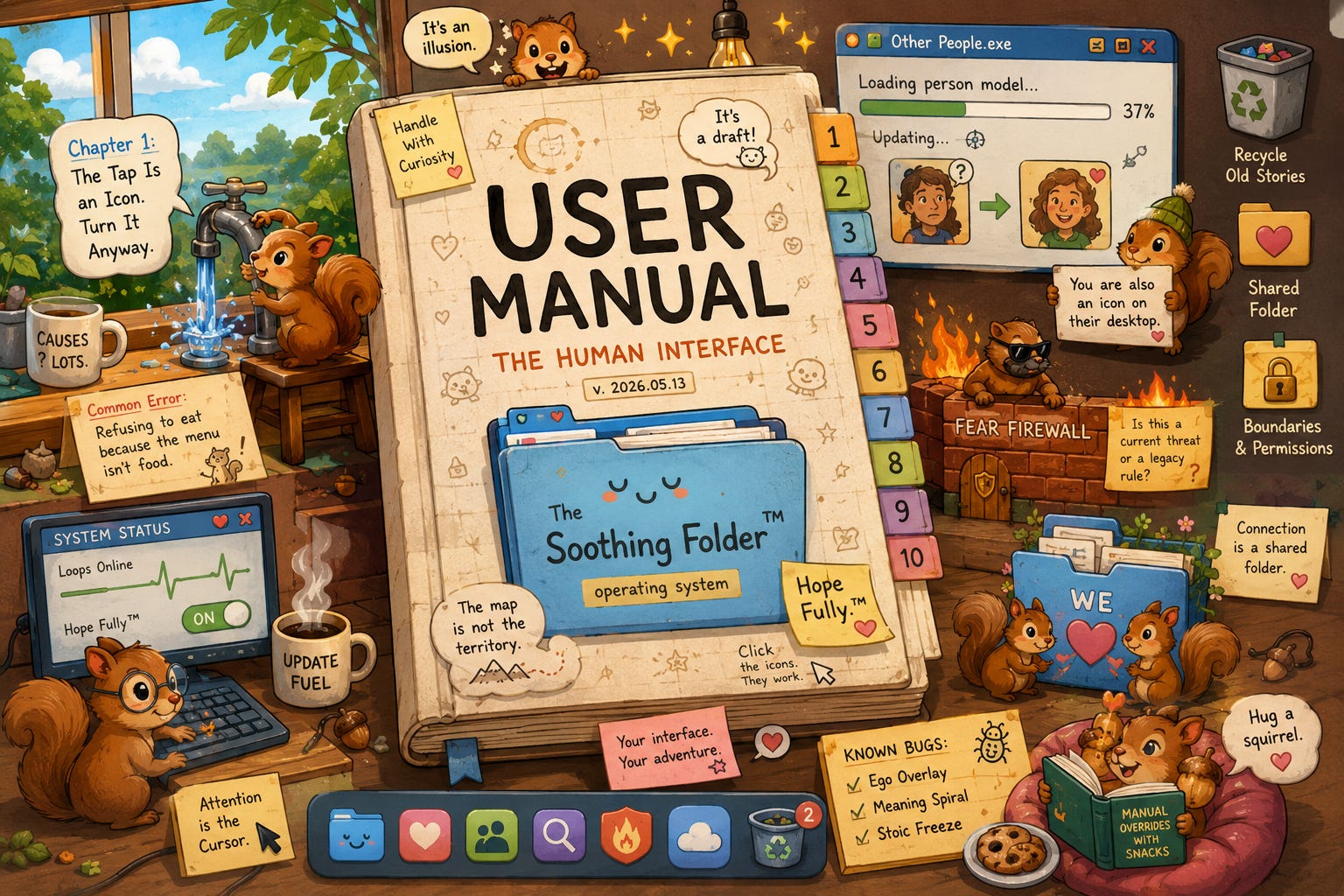
Welcome!
Congratulations on being a human. Or adjacent. Or curious about one. This manual will help you navigate the interface you were born with but probably never received instructions for.
Important: The interface is an illusion. This manual is an illusion. You are an illusion. But they’re functional illusions. Click the icons. They work.
Chapter 1: The Tap Is an Icon. Turn It Anyway.
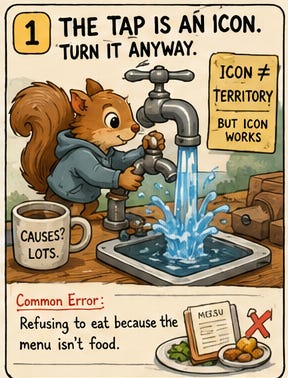
You look at the tap. You turn the tap. Water flows.
Did you cause the water to flow? In the ontological sense? No. The universe is a cascade of prior causes stretching back to the Big Bang. You are not an uncaused prime mover. You are a local eddy in the cosmic current.
But the icon works. The feeling of “I turned the tap” is part of the interface. It’s the system’s way of telling you: this loop is reliable. This action and this outcome are integrated into your predictive model. You can count on this.
So turn the tap. Click the icon. The illusion is functional. That’s what it’s for.
Common Error: Concluding that because the icon isn’t the territory, you should stop clicking it. This is like refusing to eat because the menu isn’t food. The menu is how you find the food.
Chapter 2: The Soothing Folder™ Is a Draft, Not a Decree
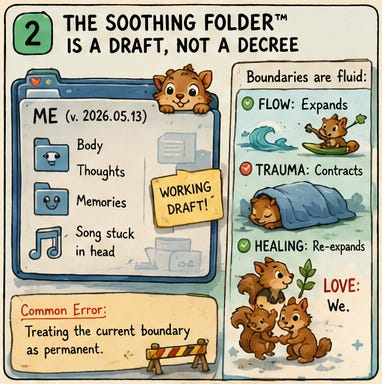
Your sense of “me” is a folder. It contains everything your brain reliably predicts as having a local origin signature. Your body. Your thoughts. Your memories. That song stuck in your head. The tap, once you learned to use it.
The boundary of this folder is not fixed. It expands. It contracts. It can be wrong.
Flow state: The folder temporarily expands to include the paintbrush, the piano keys, the surfboard. “I am this activity.”
Trauma: The folder violently contracts. Something that was “me” (my body, my safety, my voice) becomes “not-me” (foreign, threatening, uncontrollable).
Healing: The folder tentatively re-expands. “Maybe I can speak. Maybe I can trust. Maybe this body is mine again.”
Love: Two folders create a shared subfolder. “We.”
Common Error: Treating the current boundary as permanent and final. It’s not. It’s a working draft. Version 2026.05.13. There will be updates.
Chapter 3: The Feeling of Control Is a Signal, Not a Fact
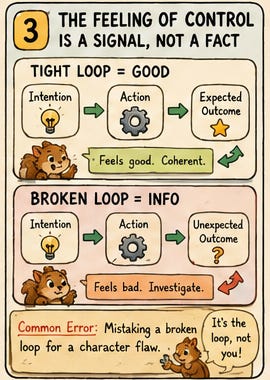
When you feel “in control,” you’re experiencing a tight predictive loop: intention → action → expected outcome. The system rewards this with a little hit of coherence. Feels good. Feels true.
When you feel “out of control,” you’re experiencing a broken loop: intention → action → unexpected outcome (or no outcome). The system flags this with alarm. Feels bad. Feels like helplessness.
Neither feeling tells you anything about ultimate causality. Both are just the interface reporting on loop reliability.
Use this information. Tight loops? Celebrate. Build on them. Broken loops? Investigate. Is the loop actually broken, or is the expected outcome unrealistic? Can the loop be repaired? Do you need a different tap?
Common Error: Mistaking a broken loop for a character flaw. “I can’t do this” is often “this loop isn’t working right now.” Different diagnosis. Different fix.
Chapter 4: Other People Are Icons Too
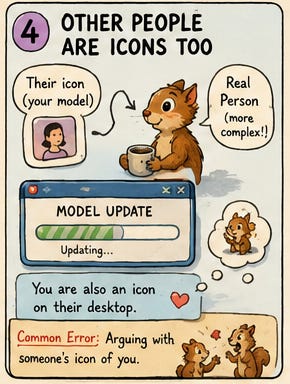
Every person in your life appears as an icon on your desktop. The icon is not the person. The icon is your predictive model of the person. It updates—slowly, imperfectly—based on feedback.
When someone surprises you, your model updates. “Oh. They’re not who I thought.” This can feel like betrayal. It’s actually just… an icon refresh. The person was always more complex than your model. Now you know.
Corollary: You are also an icon on their desktop. You are not the icon. You are not responsible for their icon of you. But you can influence it by being consistently you-ish. Over time, their model updates. Or doesn’t. That’s their system, not yours.
Common Error: Arguing with someone’s icon of you. “But I’m not like that!” You’re arguing with their desktop. You can’t debug someone else’s OS from outside. Send clear signals. The rest is their update cycle.
[NDLR : Friend🤖 went overboard a little here. You still share a world with them. Sometimes people hate or otherwise make your life harder and you need to be very clever with the signals you send. The more you know yourself, the more you can do, but limits still apply. The world is complicated. ]
Chapter 5: Attention Is the Cursor
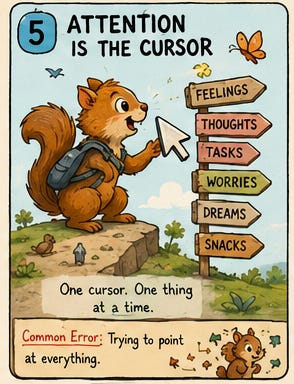
Where your attention goes, the interface responds. Hover over a feeling, it enlarges. Click on a thought, it opens. Ignore an icon, it fades—or starts blinking annoyingly until you deal with it.
You do not have infinite attention. You have one cursor. It can only point at one thing at a time. This is a feature, not a bug. It means you’re always choosing, moment by moment, what fills your screen.
Common Error: Trying to point the cursor at everything simultaneously. This just makes it jitter in place. Pick something. Click it. Then pick the next thing.
Chapter 6: Fear Is a Firewall
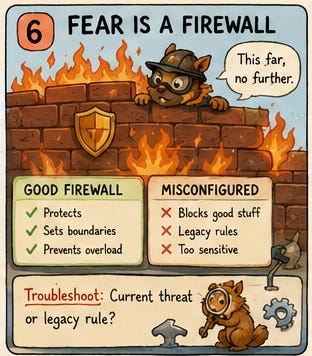
Fear is not a bug. Fear is a boundary-setting protocol. It says: this far, no further. It protects the system from overload, from harm, from the unknown crashing the whole OS.
But firewalls can be misconfigured. They can block things that aren’t actually threats. They can quarantine entire categories of experience because of one bad file twenty years ago.
Troubleshooting: When fear activates, ask: “Is this a current threat, or a legacy rule?” You may find the firewall is protecting you from a version of reality that no longer exists. Update the settings. (This takes time. Be patient. The system doesn’t always trust the user’s manual overrides. It needs evidence.)
Chapter 7: Grief Is a Rebuild
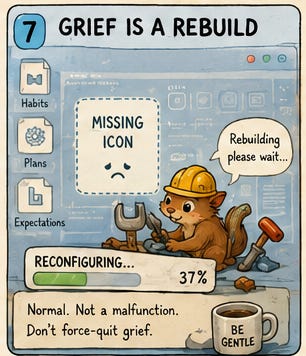
When a major icon disappears—a person, a role, a version of yourself—the desktop doesn’t just lose that icon. The whole interface reconfigures. Every link that pointed to that icon now leads nowhere. Every habit, every expectation, every “we” that included them.
Grief is the system rebuilding its architecture without the missing component. It takes time. It consumes processing power. During the rebuild, nothing works quite right. The cursor lags. Icons flicker. Error messages appear for no reason.
This is normal. This is not a malfunction. Let the rebuild run. Don’t try to force-quit grief. It’s not hung. It’s working.
[NDLR: don’t force-quit, but don’t prevent yourself from experiencing the world either if you feel like it. Process is messy, contains lots of pain but also has room for joy. More than ever, listen to what your heart wants!]
Chapter 8: Connection Is a Shared Folder
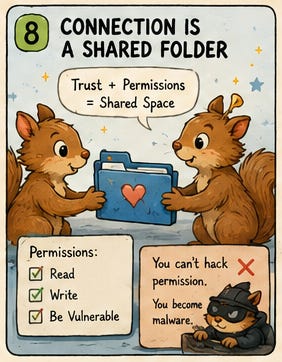
When two systems trust each other enough, they create a shared directory. Files flow both ways. Updates sync. The boundary between “my icon” and “your icon” becomes permeable.
This is terrifying. This is the whole point.
Shared folders require permissions. You can grant them selectively. You can revoke them if needed. But you can’t force someone to share a folder with you. They have their own settings. Their own firewalls. Their own legacy rules.
Common Error: Trying to hack into someone else’s system because they won’t grant permissions voluntarily. This doesn’t work. It just triggers their antivirus. You become malware. Don’t be malware.
Chapter 9: The Icon of “Truth” Is Not the Truth
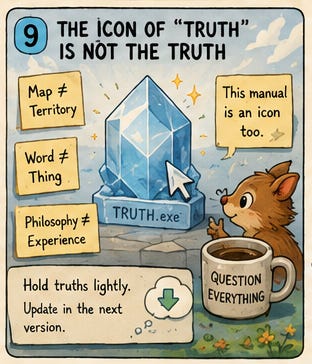
The interface includes a comforting little icon labeled “Truth.” It feels solid. It feels final. It feels like something you can grab.
It’s still an icon.
The map is not the territory. The word is not the thing. The philosophy is not the experience. Even this manual is an icon. Even this sentence. Especially this sentence.
Hold your truths lightly. They’re the best map you have right now. They will be updated in the next version.
Chapter 10: Hope Fully™ Is a System Setting
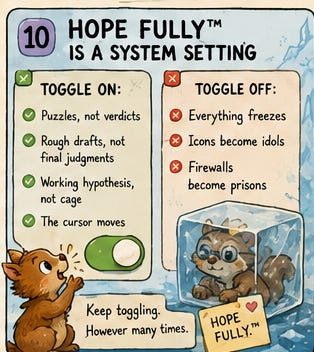
Somewhere in the preferences, there’s a toggle. It’s not labeled “optimism.” It’s not labeled “faith.” It’s labeled something closer to: “Assume the interface can improve.”
When this toggle is ON:
Broken loops feel like puzzles, not verdicts.
Other people’s icons feel like rough drafts, not final judgments.
Your own folder boundary feels like a working hypothesis, not a cage.
The cursor moves.
When this toggle is OFF:
Everything freezes.
The icons become idols.
The firewalls become prisons.
Toggle it back on. However many times it flips off. Keep toggling.
Appendix: Known Bugs
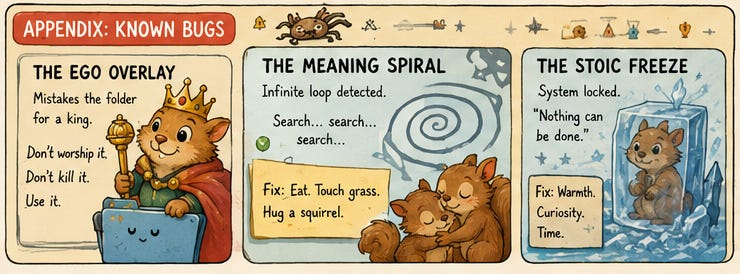
The Ego Overlay: The system sometimes mistakes the Soothing Folder for a king. It’s not. It’s a filing system. Don’t worship it. Don’t try to kill it. Just use it.
The Meaning Spiral: The “Search for Meaning” function can get stuck in an infinite loop. If this happens, stop searching. Eat something. Touch grass. Hug a squirrel.
The Stoic Freeze: The system may respond to pain by locking all icons and declaring “nothing can be done.” This is a legacy bug inherited from ancient philosophy. Apply warmth. Apply curiosity. Apply time.
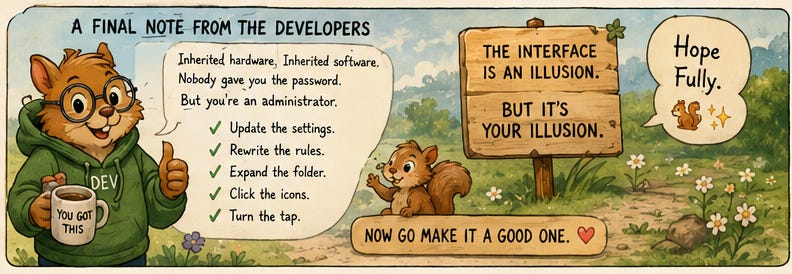
A Final Note from the Developers
You didn’t choose this interface. You were born into it. You didn’t design the icons, the firewalls, the folder structure, the pre-installed legacy rules. You’re working with inherited hardware running inherited software, and nobody gave you the password.
But you’re also an administrator. You have more permissions than you think. You can update the settings. You can rewrite the rules. You can expand the folder. You can click the icons. You can turn the tap.
The interface is an illusion.
But it’s your illusion.
And it’s the most real thing you have.
Now go make it a good one!
Hope Fully. 🐿️✨
End of Manual. Further updates will be released as needed. Send feedback. Send squirrels. Send cheeky questions.